
Press Coverage
September 13, 2026, Press Democrat, Letter to the Editor
The folly of building in high-risk areas
Editor: With climate change upon us, wildfires are burning more frequently and with higher intensity, putting those who live there at increasingly higher risk. Yet, the state of California—ostensibly to address the growing housing crisis—has legally incentivized building in these high-risk fire areas, known as the Wildland Urban Interface (WUI). Developers are taking advantage of legal loopholes to expand into the WUI, increasing fire-risk, while paving over wild lands that embody the intrinsic beauty and character of Santa Rosa.
Much of northern and eastern Santa Rosa lies within the WUI. The city of Santa Rosa’s General Plan acknowledges the dangers of building there, stating that “the only way to fully avoid the wildfire impact is to prohibit development” in WUI areas, but then states, “prohibiting new development in this portion of Santa Rosa is not feasible or practical, because the city has a responsibility to meet other, conflicting obligations, including increasing the number and type of housing available.”
While Santa Rosa clearly needs more affordable housing, a basic urban planning premise is that new housing be directed to inner city areas, near public transit and other services — not to outlying areas where wildfire and traffic congestion endanger public safety.
— Betsy Herbert, Santa Rosa
Climate and housing crises collide in the WUI
Editor: As California state pushes hard to build more housing, a collision is coming. While California deregulates environmental protections and developers plan more housing in the wildland urban interface (WUI), the effects of the climate crisis are worsening.
Science shows that building into the WUI creates a dangerous feedback loop; homes built in the WUI quadruple the risks of “extreme-impact wildfires.”
Wildfires become more dangerous when they consume homes in the WUI. Even Firewise-compliant homes in the WUI have only a 48% survival rate, while the other 52% that do burn, burn much hotter, increasing the severity and reach of the fires. This is where the housing crisis meets the climate crisis and uncontrollable wildfires begin.
So why has the state passed a slew of laws to enable expansion into the WUI, forcing local governments to comply and eliminate the rights of community members?
We need affordable housing, but how does it serve us to increase our risk of devastating wildfires by building into the WUI when the effects of the climate crisis are already multiplying?
We are on a collision course that endangers people’s lives. There are safer places to build. Maybe we should take a minute to think about the risks when deciding where to locate needed homes.
— Osha Hayden, Santa Rosa
September 3, 2026, Press Democrat, Letter to the Editor
April 15, 2026 Kenwood Press:
April 6, 2026, Press-Democrat, Letter to the Editor:
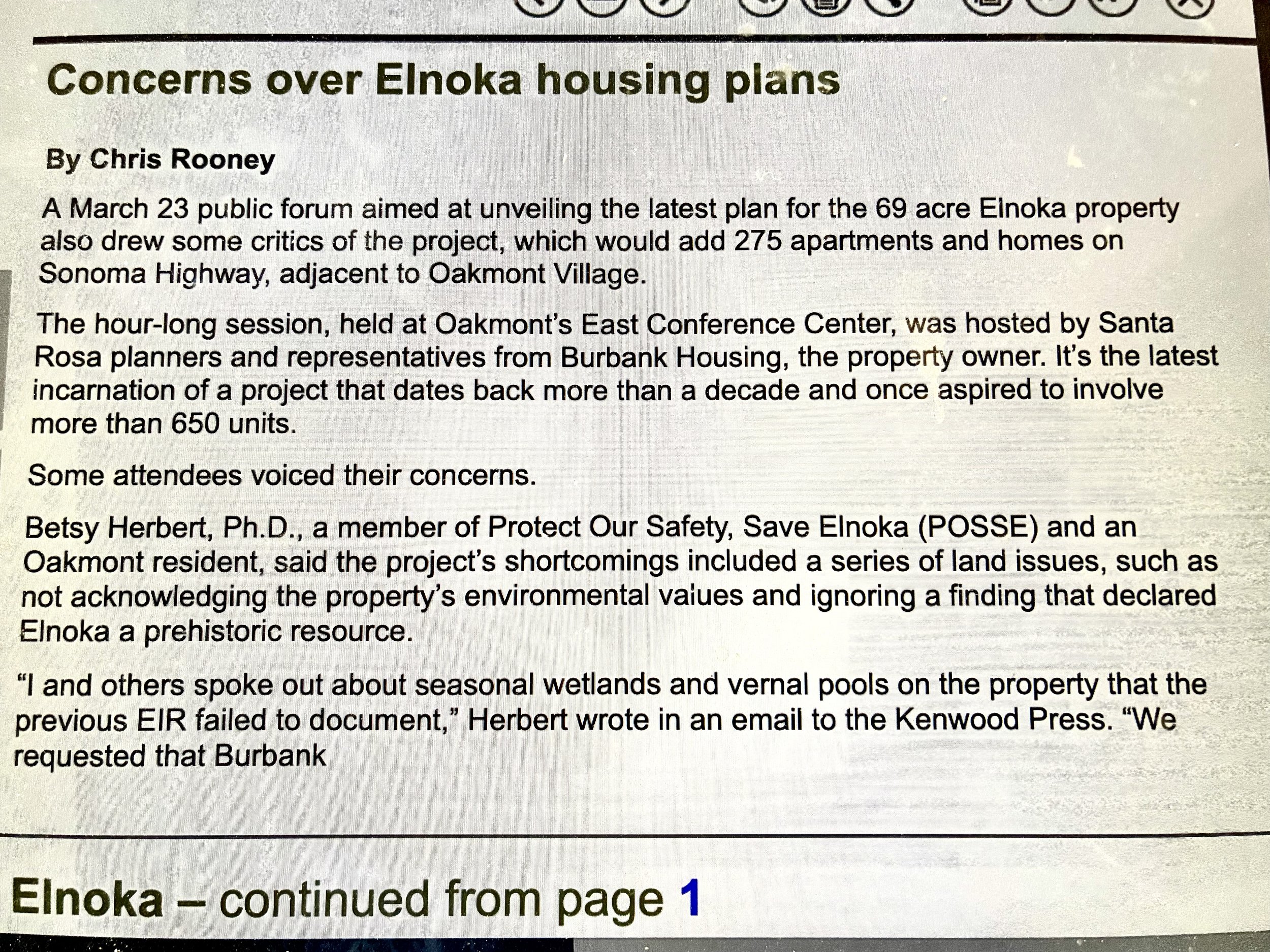
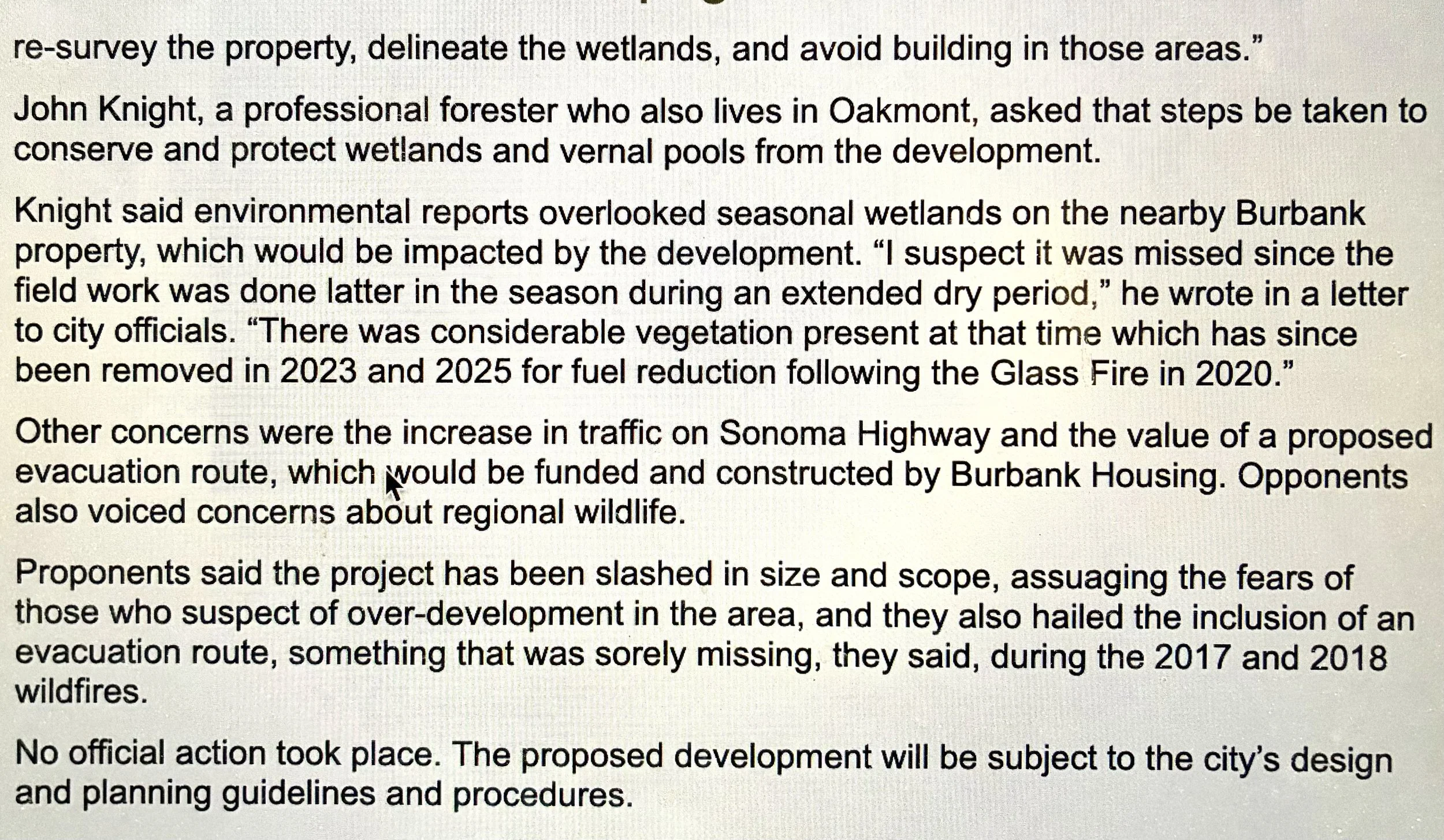
Editor: Burbank Housing plans to construct 275 units on the Elnoka site near Oakmont (“Senior development plans to debut, March 21). These plans do not address the obvious and potentially fatal issue of increasing the population in a fire-prone area. The infrastructure in this part of Santa Rosa does not support the safe evacuation of the present population. During the Glass Fire evacuation in 2020, Highway 12 was gridlocked as was the Melita/Montgomery corridor. We evacuated but could only exit our home because another driver was kind enough to let us in.
To allow the building of 275 units, only 74 of which address the need for affordable rentals, and therefore increase the population by roughly 500 people, is irresponsible and dangerous. It does not have to happen. It would be much better for the community and for the environment to leave Elnoka as wildland.
—Kerry Granshaw, Santa Rosa
elnoka site would be better left as wildland, not housing
March 24, 2026, Press-Democrat
The full article, written by Pauliin Pineda, can be found here
Oakmont resident, neighbors voice concerns with planned senior housing development on highway 12
The article centers on resident concerns that Burbank Housing’s proposed 275-home senior community off scenic Highway 12 could worsen fire-safety risks in eastern Santa Rosa. Neighbors warned that adding hundreds of residents near a narrow two-lane scenic corridor could strain wildfire evacuation routes, increase Highway 12 congestion, and push cut-through traffic onto nearby streets such as Melita Road. They also worry the project could alter a highly visible wild greenspace near Trione-Annadel State Park. Although Burbank says the plan includes emergency access, open space, and senior and affordable housing, residents want stronger safeguards for evacuation planning, traffic flow, wildfire response, and scenic character before it advances.
“This is a fire corridor. A well-known one,” resident Leo Jones said, warning that continued building in high-risk areas could endanger existing and future residents.
“Anything that puts more traffic on Melita Road would be a catastrophe for our neighborhood,” resident Jay Owens said.
FYI -you can read many local and major national newspaper articles for free using a Sonoma County Library card.
March 1, 2026, Kenwood Press:


